
Honeric de Gonde
New member

Artworks:
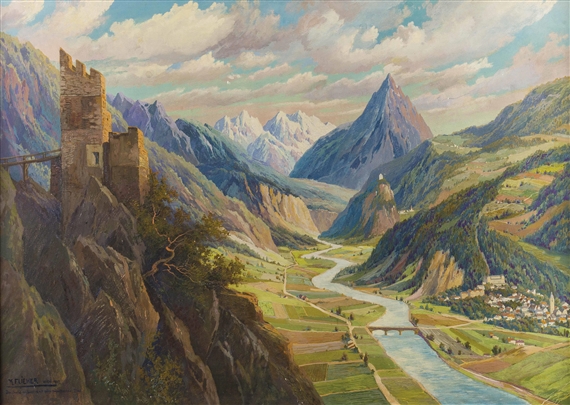
The View from Schroffenstein, Karl Flieher, 1927
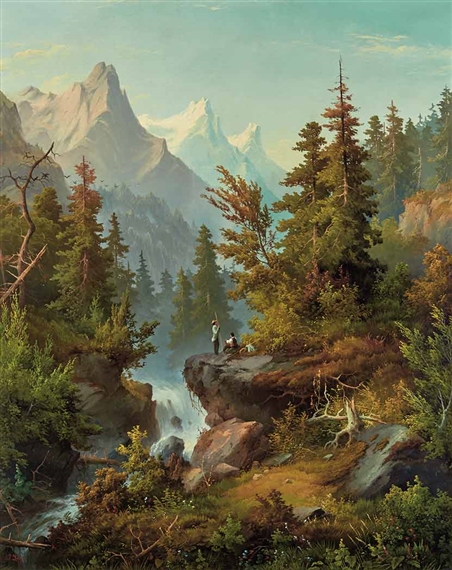
Hikers in the Valley, John J. Zang, 1984
The View from Schroffenstein, Karl Flieher, 1927
Hikers in the Valley, John J. Zang, 1984
Out of Character Information
- Objective: To detail the fiefdom that belongs to the family of @Honeric de Gonde
- Category: County
- Image Credit: (x)(x)
- Development Thread: N/A as of yet
- Permissions: N/A
General Information
- Name: Grafschaft (County) of Obereisen (Upper Eisen)
- Geographical Features:
- Rivers
- Coniferous Forests
- Alpine Foothills
- Mountains
- Pastures
- Climate: The climate of Obereisen is primarily subalpine, with pleasant springs and summers, followed by harsh mountain winters. The southernmost parts of the county are located in the alpine regions above the treeline, a cold and stark wilderness year-round.
- Terrain: Obereisen is a rugged land in the foothills of the Tanast Mountains. Sweeping vistas look down upon pock-marked glacial valleys, still flowing with run-off mountain waters draining into the main course of the Eisen river. In the north of the county, thick coniferous forests give the northern Tanast piedmont a dark blanket of evergreen. As the piedmont rises into the Tanast mountains themselves, the natural meadows approaching the treeline roll out, providing idyllic pastoral land for cattle, sheep, and goats. As the treeline thins with altitude, harsh and constant winds create thickets of Krummholz trees, above which the peaks of the mountains begin, bounding the realms of the Ostermen. The entire county sits upon the east bank of its namesake, the Eisen river, the regions most prominent feature. Bounding the realm to the south are the Eisenfalls, where the river, carving through the Bourgon Gorge (called the Burguntal to the Ostermen), rapidly descends the mountains and rushes into the heart of Eroba.
- Natural Resources:
- Softwood
- Quarried Metamorphic Stone
- Quartz Crystal
- Precious Metals
- Garnet
- Demographics: Obereiseners are sparse in population, spread out between small valley hamlets, semi-nomadic pastoralists, and river fishermen. Self-sufficiency and closeness to the land are valued by the denizens of the Annenfeld woodlands and the higher parts of the mountains, where transportation and communication are limited by the rough terrain. Obereiseners along the river tend to be more cosmopolitan, sharing culture across the river with the Bourgonians on the western bank of the Eisen, as well as with Ostermen further down the river to whom both sides of the river ferry goods. Obereiseners broadly are known to be short and stocky, subsisting on diets of lamb, goat cheese, various milks, and river fish.
- Religion: Curia
- Languages: Obereiseners are primarily Ostermen, speaking the Ostermanni tongue, although many who live directly on the river also speak a modicum of the Merelaisien tongue in order to facilitate trade acorss the border. Around the Bourgon Gorge and the Eisenfalls, where the border between the two kingdoms is more difficult to enforce and the cultural differences are less important, a mixture of the two languages is spoken.
- Key Industries:
- Forestry is an adundant industry. In the deeper woods, many charcoal kilns are to be found, whilst along the river, fine softwoods like pine and fir are ferried down the river to be sold in Eroban markets.
- Animal husbandry in Obereisen often takes the form of herding, as only a fraction of the land directly along the river is suited for agriculture. High in the alpine meadows, pastures of sheep and goats are very common, with some herdsmen also keeping hardy, hairy cows that have adapted to the altitudes.
- A handful of mines exist in Obereisen, one notably near the Gonde castle exracting ores with copper and some silver. Higher up the mountains, miners often seek crystals like quartz and garnet, which are highly sought after for gems in the rest of Eroba, but difficult to mine.
- Haulage and shipping play a vital role in the local economy of Obereisen on top of the above. Riverboats laden with goods can be found cruising down river, then being pulled back up the river by teams of horses on the shore, which has led to a high demand in the region for strong and enduring workhorses.
Overview
- Geographical Highlights: (Provide a list and brief descriptions of any notable landmarks or distinctive regions that contribute to the province's identity. This section is reserved for naturally occurring features, such as mountain ranges, hot springs, crystal caves, etc. Provide links to any relevant Annals submissions, if applicable.)
- Landmark1: <Description>.
- Fauna: (Provide a summary of the common fauna one might encounter throughout the province, including both domesticated species and wildlife. In addition, list and describe any extraordinary creatures found in the province, such as mythical beasts, aberrant monsters, or regional variants of common animals. Provide links to any relevant Annals submissions, if applicable.)
- NotableCreature1: <Description>.
- Flora: (Provide an overview of the typical plant life that populates the province. In addition, list and describe any extraordinary plants found in the province, such as magical fruits, rare spices, or valuable alchemical herbs. Provide links to any relevant Annals submissions, if applicable.)
- NotablePlant1: <Description>.
- Inhabitants: (Provide a list and describe any prominent cultures and intelligent races that inhabit the province. Briefly outline their respective lifestyles, covering elements such as governance, laws, customs, and any distinctive practices or traditions. Provide links to any relevant Annals submissions, if applicable.)
- Inhabitant1: <Description>.
- Settlements:
-

Historical Information
The modern history of the Grafschaft of Obereisen begins a century ago with the reign of Chief Gundobad, or Gondebaud, who ruled the pastoral highland tribes of the region on both sides of the Eisen in the reign of King Mavis of Merevingia. In these days the Upper Eisen was wild and untamed, what was once an important borderland of the Priman Empire fell into obscurity and desolation with the Empire's collapse. The Ostermanni of the area had arrived some three centuries ago, living as Foederati to the Empire and converting to the Curia, though they sought splendid isolation in the mountains for the most part. Gundobad bucked this trend, gathering hardy mountain warriors to raid up and down the Eisen river. When his raiding could be tolerated no more, King Mavis invited the Chief to court to speak of terms for peace. At Parleaux, the miracle of love befell Gundobad, who became smitten with the King's sister, the princess Clotilde. Her charm and graceful magnanimity eased tensions between the the King and the Chief, and captured Gundobad's affections. The Chief demanded in exchange for eternal peace between the mountain men and the Merevingians, that he would have Clotilde's hand in marriage. To this King Mavis was said to have laughed, imagining that he would ever give away his sister to a barbarian lord. Determined to officiate the love growing between him and the princess, Gundobad sweetened the deal, offering to Mavis the rights to a gold mine high in the mountains, leasing his land west of the river Eisen to the crown, relequishing its wealth. Realizing that Gundobad was serious about such a proposal, Mavis accepted the gold mine as Clotilde's Dowry, which to this day is the name of the town surrounding the mine in what is now Bourgon.
Gundobad and Clotilde wed, and in doing so intrinsically tied the mountain tribes to Merevingia. With her education, Clotilde became a vitalizing force in the region, connecting merchants from the lower Eisen to the vast wealth of possibilites upriver. So too did her cultural influence impact the tribesmen of Gundobad, many of whom followed him in adopting the courtly manners of his lady wife. For Clotilde, Gundobad would build a new home, which came to be known as Castle Gonde, still the seat of his progeny today. The construction of the river fort, built of the finest stoned quarried from the Tanast mountains, brought many people in the region to settle along the river, clearing land for agriculture and paving way for Merevingia's feudal system to settle in.
The reigns of Mavis and Marloman were prosperous for the Upper Eisen, until the fateful division of Merevingia into Merelais and Ostrien. Though the profits of Clotilde's Dowry had long flowed to the royal treasury, and the Obereiseners had been fervent supportors of the holy wars against their pagan cousins, the realm was not spared the sundering. The lands west of the Eisen, leased to the crown, were officially severed as the Eisen became the border. Castle Gonde was henceforth a border fortress, though fortunately in a region that would be less contentious than further down the river. It was here that the Grafschaft of Obereisen was truly born, and its ruler, Alberic, father of Honeric, was elevated to Markgraf (Margrave/Marquis/Marcher) to symbolize his role as a defender of the borders.
Last edited: